


Distributacon Inc.
6035 Queens Ave NE Ste. 200
Otsego, MN 55330, USA
Why a Proper Trampoline Bounce Matters: The Superiority of ACON Trampolines
9 Mins Read

Last updated on October 21, 2026
A proper trampoline bounce slows the body through controlled vertical deceleration instead of stopping it abruptly. A rigid frame, responsive suspension, stable mat, and secure enclosure work together to spread landing forces over more time and surface area. This reduces peak joint stress, supports predictable landings, and gives children and adults better control. ACON trampolines use thick steel frames and coordinated spring-and-mat engineering to deliver a stable, consistent rebound rather than a deep, unstable dip.
Understanding the Physics Behind Low-Impact Vertical Deceleration
A well-designed trampoline can reduce the hard, jarring impact you would expect on a surface such as a pavement, by extending the time and distance over which the body decelerates.
When you run on asphalt, the surface barely moves. Your foot stops quickly while the ankle, knee, hip, and spine absorb the remaining impact. On a trampoline, the mat and suspension system stretch under load. This turns an abrupt stop into controlled vertical deceleration.
Depending on the equipment, landing style, and testing method, an elastic surface may absorb or redistribute up to 80% of the kinetic shock that would otherwise pass more directly into the skeletal frame. This figure is not universal, but the underlying principle is consistent: a longer deceleration period generally produces a lower peak force.
The springs are only one part of the system. A proper bounce depends on the connection between the mat, spring arrangement, and frame. ACON’s Synergy Design is intended to make these parts respond together, while its engineered springs deliver a consistent rebound. Learn more about ACON suspension options when choosing a trampoline spring set.
This controlled loading also relates to Wolff’s Law. Bone adapts to the mechanical demands placed on it, provided the load is appropriate and recovery is adequate. Moderate, repeated loading can encourage the body to maintain or strengthen bone tissue. Excessive or poorly controlled impact, however, may strain joints and connective tissue.
Not all trampolines provide the same benefit. A thin budget frame may flex or bow inward under a jumper’s weight. If the mat slopes toward the center, the feet can follow that angle, encouraging ankle pronation and inward knee movement. A thick-walled steel frame resists deformation, helping the mat remain level and the rebound stay vertical.
Surface and Bounce Comparison
| Factor | Pavement Running | Budget Spring Trampoline | Premium ACON Trampoline |
|---|---|---|---|
| Surface response | Nearly rigid | Elastic but often uneven | Elastic and engineered for consistent response |
| Deceleration | Abrupt | Variable | Smooth and controlled |
| Frame behaviour | Not applicable | May flex or bow inward | Thick-walled steel resists deformation |
| Ankle and knee alignment | Depends on running form | Sloped mat may encourage inward rolling | Stable mat supports more neutral landings |
| Rebound direction | Forward and vertical | May pull the jumper toward the center | Predictable vertical rebound |
| Peak joint impact | Relatively high | Moderate but inconsistent | Reduced through progressive deceleration |
| Best use | Running and sport-specific conditioning | Occasional recreation | Controlled exercise and family recreation |
Rebounding Benefits: How G-Force Activates Lymphatic Drainage
Alternating acceleration and deceleration during rebounding trampoline exercise encourages muscle contractions that help move lymphatic fluid through the body.
Unlike blood circulation, the lymphatic system has no central pump comparable to the heart. It relies on muscle contractions, breathing, and body movement to transport lymph through one-way vessels. During a proper trampoline bounce, the body experiences changing gravitational force. The jumper feels relatively light near the top of the bounce and greater loading as the mat reaches its lowest point.
This repeated change in g-force causes the leg, abdominal, and postural muscles to contract and relax. Those contractions can support the normal movement of lymphatic fluid, which carries immune cells and helps transport cellular by-products. Rebounding does not literally detox the body or replace the work of the liver and kidneys, but it can contribute to the movement that healthy lymphatic circulation requires.
A controlled bounce is especially useful because it can create this pumping action without the hard foot strike associated with running. Beginners do not need to jump high. A health bounce, where the feet remain on or close to the mat, is enough to introduce rhythmic loading and muscle activation.

Boosting Bone Density and Protecting Joints Over Time
Regular, appropriately scaled weight-bearing exercise can support bone health while a responsive trampoline surface reduces the abrupt joint loading associated with pavement running.
According to Wolff’s Law, bone remodels in response to mechanical stress. Small, repeated loads signal bone-forming cells called osteoblasts to maintain and build bone tissue. Rebounding provides this stimulus each time the jumper lands and changes direction.
The benefit depends on intensity, frequency, and the individual. A gentle bounce may be appropriate for general movement, while a higher bounce creates greater loading and requires more strength and control. People with osteoporosis, recent fractures, joint instability, or other medical conditions should ask a qualified healthcare professional whether rebounding is suitable.
Running remains an effective cardiovascular and bone-loading exercise, but pavement returns impact quickly. A trampoline mat stores part of the landing energy and releases it during the next rebound. This gives the hips, knees, and ankles more time to manage force.
Calorie expenditure varies with body weight, pace, technique, and workout intensity. The figures below are practical ranges rather than guarantees.
| Metric | Running on Pavement | Rebounding |
|---|---|---|
| Typical impact pattern | Repeated hard foot strikes | Progressive mat-assisted deceleration |
| Primary muscles | Quadriceps, calves, hamstrings, glutes | Calves, quadriceps, hamstrings, glutes, deep core |
| Stabilizing demand | Moderate | High due to the moving surface |
| Approximate calorie burn per hour | 500 to 900+ | 300 to 700+ |
| Joint loading | Higher and more abrupt | Lower peak impact when the bounce is controlled |
| Balance requirement | Moderate | Continuous vertical and lateral correction |
| Workout progression | Speed, incline, and distance | Bounce height, tempo, movement pattern, and duration |
A proper trampoline bounce is not automatically safer just because the surface is soft. Technique still matters. Jumpers should begin with low bounces, keep their knees aligned over their feet, and avoid fatigue-driven movements that reduce landing control.
The Neurological Edge: Enhancing Proprioception and Vestibular Balance
Every bounce requires the brain to process changes in body position, speed, pressure, and direction within fractions of a second.
Proprioceptors in the muscles, tendons, and joints tell the brain where the limbs are positioned. The vestibular system in the inner ear detects head movement and acceleration. A trampoline challenges both systems because its surface changes under the jumper’s feet.
As the mat descends, the ankles, knees, hips, and core make constant micro-adjustments. The eyes also help stabilize orientation by tracking the surrounding environment. With regular practice, this combination can support coordination, dynamic balance, reaction time, and body awareness.
Children can use age-appropriate bouncing to practise motor planning and spatial control. Adults may use rebounding to add balance work to a fitness routine. The best trampolines for proper bounce and safety provide a predictable surface, because an erratic rebound makes it harder to learn consistent movement patterns.
Balance gains are not limited to high jumps. Controlled weight shifts, gentle jogging, alternating knee lifts, and low bounces can all challenge proprioception. A stabilization handle may provide extra confidence, particularly for beginners, older adults, or people returning to exercise.

Sensory Regulation and Stress Relief Across All Age Groups
Predictable rhythmic movement can provide organizing sensory input and may help some people feel calmer, more focused, or more regulated after a short bouncing session.
Rhythmic bouncing supplies repeated vestibular and proprioceptive input. For some people with ADHD or autism, predictable movement may help organize sensory input during periods of restlessness or overload. Responses vary, however. Some people find bouncing calming, while others may find the same movement overstimulating.
Physical activity is also associated with changes in endorphins and neurotransmitters involved in mood, including serotonin and dopamine. Regular exercise can help manage stress and may support lower cortisol levels over time. Rebounding should not be presented as a treatment for anxiety, ADHD, or autism, but it can be an enjoyable part of a broader movement or sensory routine.
The trampoline itself affects the experience. Squeaking springs, sudden changes in rebound, and lateral mat movement can make a session less predictable. A smooth, quiet bounce trampoline offers steadier sensory input and makes it easier to follow a comfortable rhythm.
Read more about using trampolines for stress relief and the role consistent rebound quality plays in an enjoyable session.
Adult supervision remains essential for children, including those using a trampoline for sensory regulation. Keep sessions short at first, allow only one jumper at a time, and stop if the user appears dizzy, distressed, or disoriented.
Eliminating Impact Trauma: The Zero-Gap Safety Enclosure System
A zero-gap enclosure limits access to the frame and springs while helping prevent falls from the jumping surface.
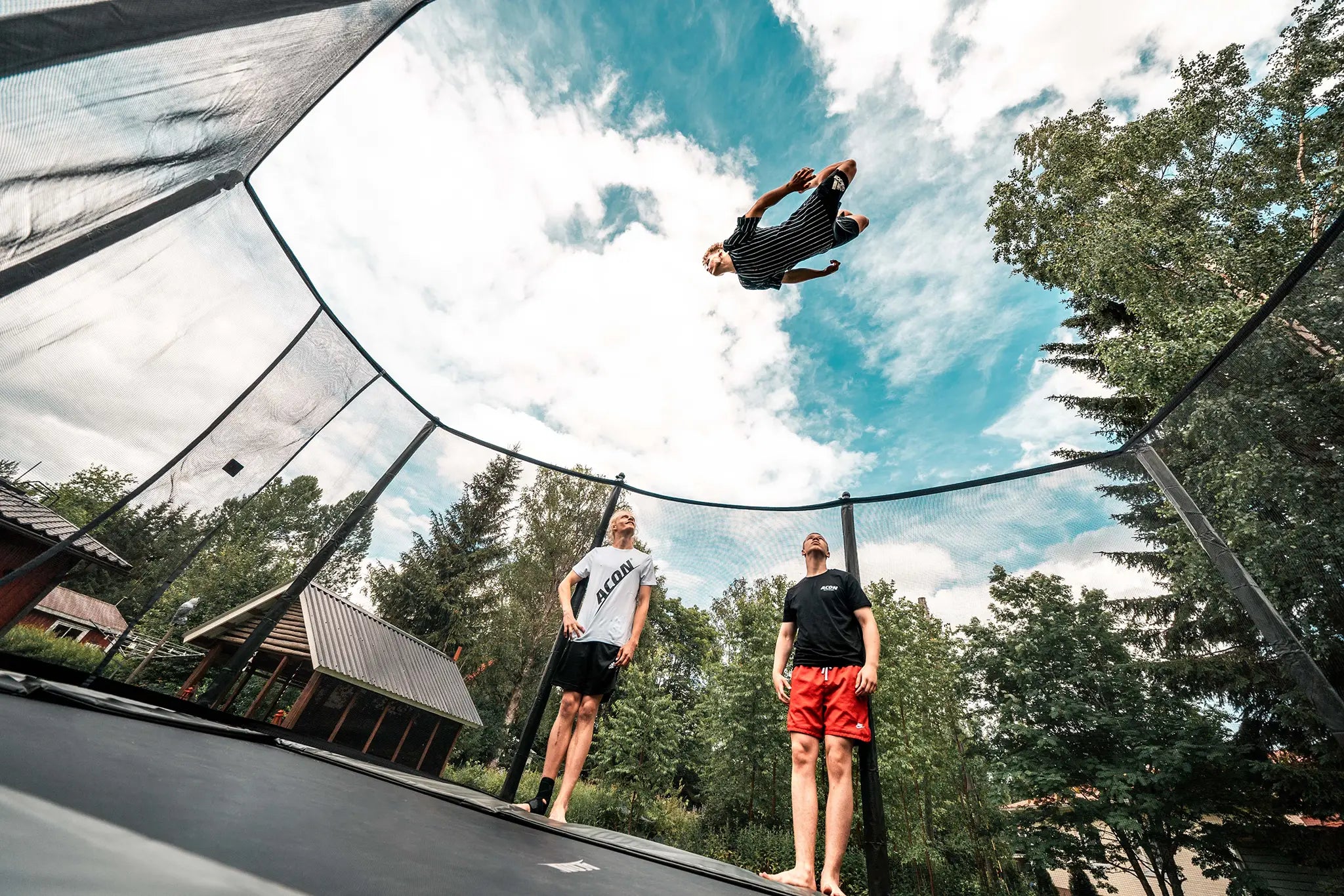
Many recreational trampoline injuries occur when a jumper lands on the frame or springs, collides with another person, or falls from the trampoline. An enclosure is therefore part of the core safety system, not a decorative accessory.
Traditional enclosure designs can leave a space between the mat and surrounding net. A foot or leg may enter that opening during an off-center landing. A zero-gap configuration connects the enclosure at the edge of the jumping area, creating a continuous barrier between the user and harder components.
The net must also respond correctly when contacted. If it is too loose, a jumper may reach the frame or ground before the material redirects momentum. If poles are poorly positioned or insufficiently padded, they can introduce another impact point. Secure connections, durable netting, covered poles, and an entry that closes reliably all contribute to safe performance.
Enclosures do not make risky behavior safe. Follow these rules for children and adults:
- Allow one jumper at a time.
- Keep flips and advanced tricks within the user’s training level.
- Inspect the net, springs, mat, padding, and frame regularly.
- Keep furniture, branches, fences, and other hazards away from the trampoline.
- Place the unit on level ground and anchor it as recommended.
- Replace worn parts with compatible components.
- Supervise children and follow the product’s age and weight limits.
Customers comparing local trampoline stores specializing in proper bounce trampolines should ask to see the whole safety system. Frame rigidity, padding coverage, enclosure attachment, replacement-part availability, and installation support matter as much as the first test bounce.
The Engineering Behind the ACON Bounce: FAQ
How does the structural rigidity of an ACON frame prevent dangerous ankle pronation?
A rigid frame helps keep the mat’s perimeter level so the jumping surface does not tilt excessively toward the center under load.
When a weak frame bows inward, the mat can develop a pronounced slope. A jumper landing on that angle may allow the ankles to roll inward, followed by inward movement at the knees. This does not mean a rigid frame can correct poor technique or prevent every injury, but it provides a more stable foundation for neutral foot and leg alignment.
ACON uses heavy-duty steel frames designed to resist flex during normal use. That structural stability also helps the springs work more consistently around the mat, supporting a vertical rebound rather than an unpredictable inward pull.
Why is a silent bungee or piano-wire suspension system preferred for indoor and apartment rebounding?tle
Quiet suspension reduces repetitive mechanical noise, while a responsive spring or bungee system supports controlled low-height exercise in shared indoor spaces.
Bungees are naturally quiet because they do not have metal coils rubbing at their connection points. High-quality piano-wire springs can also remain relatively quiet when correctly engineered, installed, and maintained. Springs often provide a crisp, energetic rebound, while bungees tend to feel softer and more gradual.
The right choice depends on the user’s preferred bounce, available space, and noise requirements. Indoor rebounders should also sit on a stable floor with adequate ceiling clearance. A protective floor mat can reduce vibration transfer, but users should still consider neighbors and building rules.
Browse ACON Rebounders for equipment intended for compact home workouts.
Can the ACON stabilization T-bar handle assist in post-injury orthopedic rehabilitation?
A stabilization T-bar can provide a handhold for balance, but rehabilitation use requires approval and guidance from a qualified healthcare professional.
The handle may help a user maintain posture while performing a gentle health bounce, weight shift, or controlled stepping movement. It does not remove the demands placed on the ankle, knee, hip, or spine, and it should not be used to bypass medical restrictions.
People recovering from surgery, a fracture, a ligament injury, vertigo, or another orthopedic condition should obtain individualized advice before using a rebounder. The T-bar is a stability aid, not a medical device or a guarantee against falls.
What features contribute to a trampoline’s proper bounce?
Frame rigidity, spring or bungee response, mat tension, suspension geometry, user capacity, and assembly quality determine bounce performance.
These components need to work as one system. Strong springs attached to a flexible frame will not produce the same stable rebound as a coordinated design. Likewise, a rigid frame cannot compensate for a loose mat or worn suspension.
The key trampoline features that affect bounce for kids and adults include:
- A thick-walled frame that stays level under load
- Springs or bungees with progressive, consistent resistance
- A durable mat with even tension across its surface
- Suspension geometry that directs energy vertically
- A stated weight capacity appropriate for the user
- A zero-gap enclosure and complete frame padding
- Replacement parts that match the original system
Are trampolines with proper bounce suitable for safe landings for children?
A proper bounce improves landing predictability, but safe use still depends on supervision, one jumper at a time, suitable equipment, and age-appropriate activity.
Children have different body weights and motor skills, so equipment should respond well at lower loads rather than requiring a heavy landing to activate the suspension. A stable frame and even mat help keep the rebound centered. An enclosure adds another layer of protection if a landing moves off course.
No trampoline eliminates risk. Parents should enforce the manufacturer’s instructions, check the equipment before use, and discourage collisions, flips, and unsupervised high bouncing.
How can shoppers identify the best bounce before buying?
A consistent trampoline should decelerate smoothly, return the jumper vertically, and remain stable across the usable jumping area.
If possible, test the trampoline at different heights and positions. The mat should not pull the feet sharply toward the center or produce a sudden stop at the bottom. Listen for excessive noise and watch the frame for visible movement. Check the product’s user-weight range, warranty, replacement-part availability, and enclosure design.
The Best Bounce is the result of the full system, not one oversized spring or an especially soft mat.
Conclusion: Choose a Bounce Designed for Control
A proper trampoline bounce combines progressive deceleration, structural rigidity, predictable rebound, and a safety enclosure that keeps users away from hard components.
These qualities influence more than how high someone can jump. They affect joint loading, landing alignment, balance, sensory comfort, and confidence. A budget trampoline may feel adequate during a quick test, but uneven tension and frame flex become more noticeable as jump height and user weight increase.
ACON designs the frame, mat, springs, padding, and enclosure as a connected system. The result is a controlled bounce trampoline suitable for family recreation or low-impact exercise when used according to its instructions. For shoppers comparing the best trampolines for proper bounce and safety, that whole-system approach is what separates a premium rebound from a basic backyard bounce.


